



CSR & FinTech - Regulations
CSR report for a FinTech startup or SME: is it mandatory?
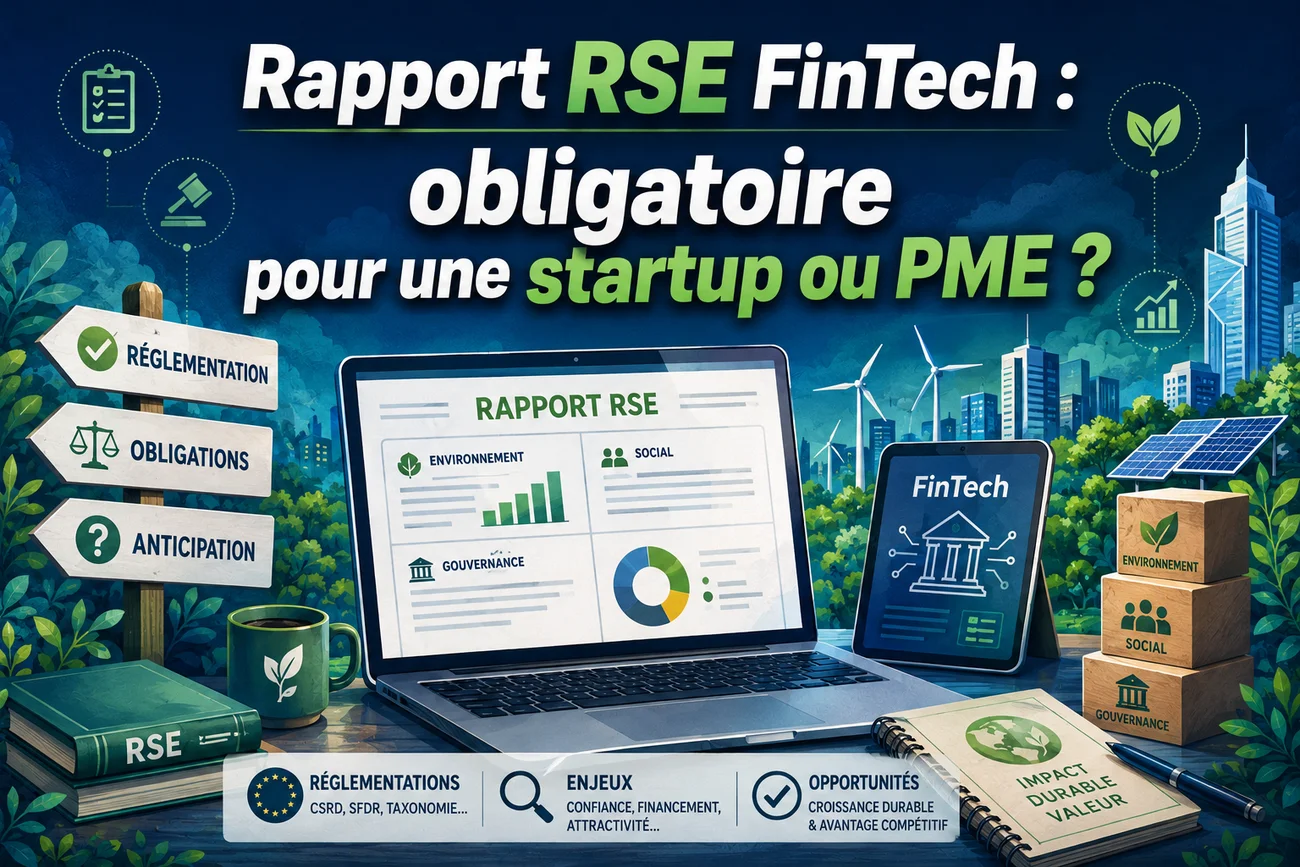
The CSRD directive imposes new non-financial reporting obligations on European companies. But depending on the size and status of your FinTech, the rules are not the same.
📋 What the CSRD says
The Corporate Sustainability Reporting Directive (CSRD) came into force at European level in January 2023. In France, it was transposed by Ordinance no. 2023-1142 of December 6, 2023. It replaces the NFRD and considerably expands the scope of companies subject to sustainability reporting.
Unlike the previous regulations, the CSRD is no longer limited to large listed groups. It is gradually being extended to all large companies, and then to listed SMEs, according to a phased implementation schedule.
📊 Application thresholds according to the size of your FinTech
The obligation depends on three criteria. To be included in the CSRD perimeter, a company must meet the following criteria at least 2 of the 3 following conditions :
- More 250 employees on average over the year
- Net sales in excess of 40 M€
- Total assets in excess of 20 M€
| Company profile | CSRD status | Mandatory reporting from |
|---|---|---|
| Large listed company or EIP >500 employees | Mandatory | Fiscal 2024 (published in 2025) |
| Large company (2 out of 3 criteria met) | Mandatory | Fiscal 2025 (published in 2026) |
| SME listed on a regulated market | Mandatory (opt-out possible) | Fiscal 2026 (published in 2027) |
| Startup or unlisted SME <250 employees | Not mandatory (for now) | No set date |
| Subsidiary of a group subject to CSRD | Group-dependent | According to the group's schedule |
Is your FinTech concerned by the CSRD?
💡 Below thresholds: no legal obligation, but real pressure
For the vast majority of French FinTech startups and SMEs, the CSRD does not yet impose any direct obligations. But the absence of a legal constraint does not mean the absence of a constraint at all.
Several factors are driving FinTechs not subject to the CSRD to voluntarily produce a CSR report:
Do you have a CSR report to design?
I take care of layout and editorial design.
📅 CSRD application timetable
Large listed companies and EIPs
Publication of the first CSRD reports for the 2024 financial year. Companies >500 employees or already subject to NFRD.
All major companies
Report for fiscal year 2025. Any company meeting 2 out of 3 criteria (250 employees / €40m sales / €20m balance sheet) is included in the scope.
SMEs listed on a regulated market
Report for the 2026 financial year, with the possibility of an opt-out until 2028. Concerns SMEs admitted to trading on a European regulated market.
Unlisted SMEs and micro-businesses
No date has yet been set. Simplified standards (VSME) are being drawn up in preparation for a possible extension of the scope.
📄 What a FinTech CSR report should contain
Whether the report is produced by obligation or by choice, its content must cover the three ESG pillars and the issues specific to the financial and tech sectors.
🎨 The design of the CSR report: a signal of seriousness
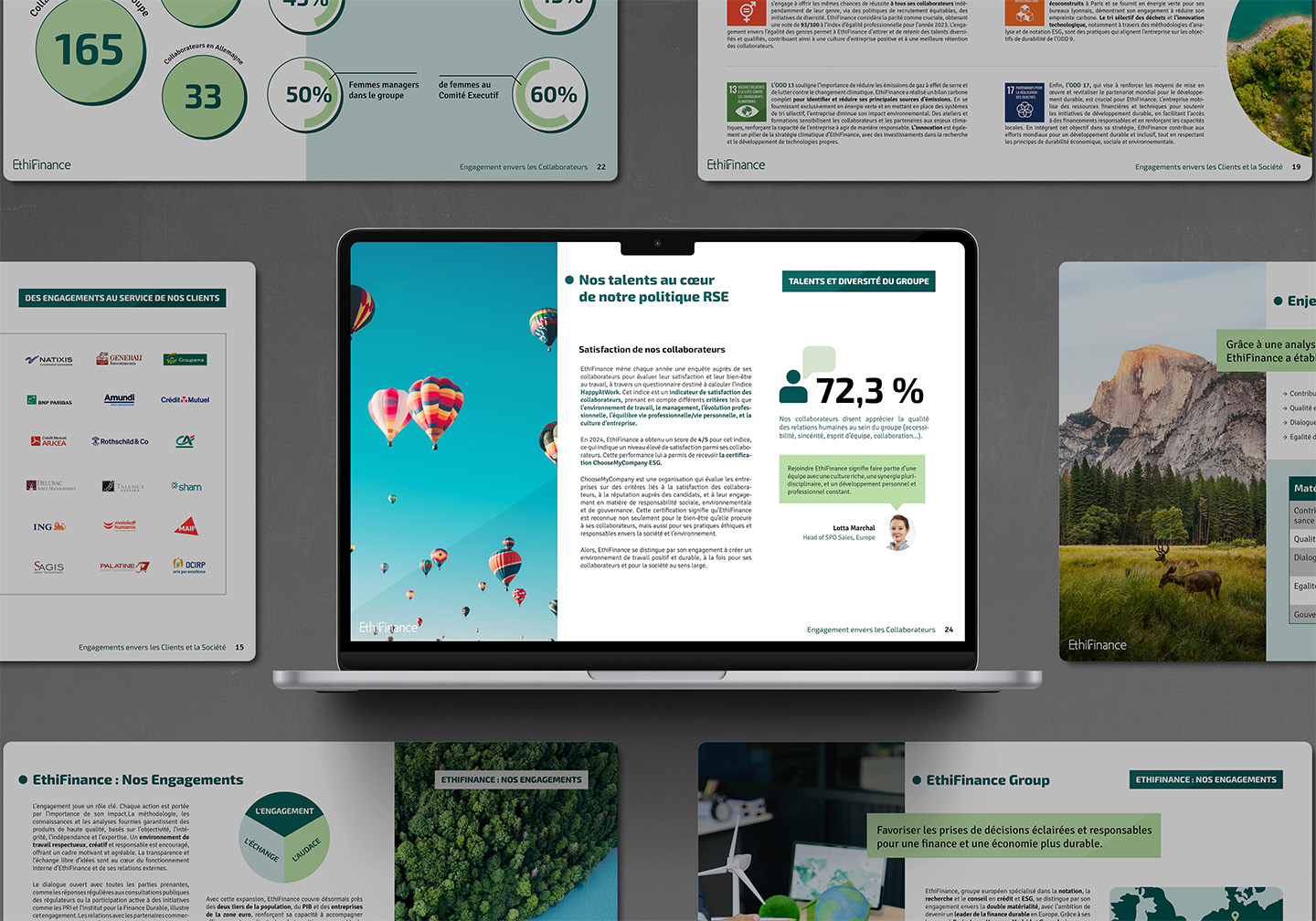
A poorly formatted CSR report undermines the credibility of the approach. ESG data is dense: KPIs, trend graphs, materiality matrices, risk maps. Without a graphic architecture, the information remains opaque to ESG investors, key accounts and extra-financial rating agencies.
A color system dedicated to each pillar is the basis of a CSR report layout readable. It enables readers to find their way around a 60 to 120-page document immediately. The five other design constraints are detailed below.
Sections E, S and G must be visually distinct on first reading. This implies a codified color system, a consistent set of sector pictograms, and an identical chapter structure for all three pillars - same headline levels, same KPI placement, same narrative sequence.
This structural consistency is not an aesthetic choice: it facilitates cross-pillar comparisons and enables ESG rating agencies to extract data quickly.
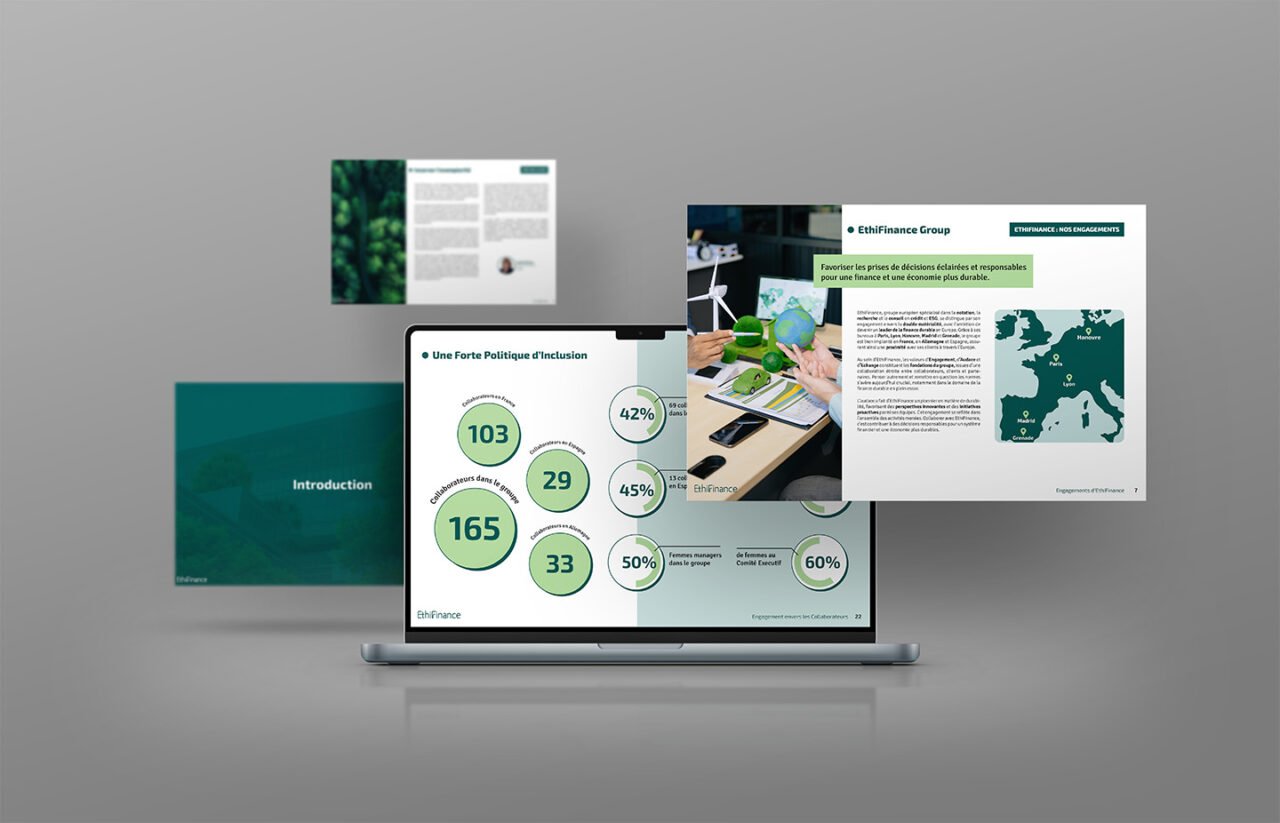
KPIs (carbon intensity, parity rate, governance score, etc.) cannot remain in textual tables. They must be presented in the form of highlighted digital cartridges, year-on-year evolution graphs, or synthetic infographics for composite indicators.
The basic rule: if a piece of data is central to a company's ESG assessment, it deserves a dedicated graphical representation.
A CSR report can be consulted on screen (interactive PDF with clickable summary, internal hyperlinks) and printed in offset for general meetings or audits. These two uses do not share the same constraints: margins, image resolutions, RGB vs. CMYK color profiles, minimum body text readable in print.
The layout must be designed from the outset for both releases - not adapted at the last minute.
Reports intended for institutional investors and regulators must comply with accessibility standards: text/background contrast ratio (WCAG AA minimum), logical tag structure for screen readers, defined reading order, alternative text on all infographics.
These constraints are managed upstream in the page-layout software (Adobe InDesign) - correcting them in post-production on an exported PDF is time-consuming and rarely complete.
Companies subject to the CSRD must publish their reports in XHTML format with iXBRL (Inline XBRL) tagging. This standard enables regulators and financial databases to automatically read ESG indicators without manual intervention.
The graphic layout must anticipate this constraint: the data to be tagged must be structured in such a way that it can be extracted and tagged without distorting the final layout.
EthiFinance Sustainability Report
I designed this sustainability report for EthiFinance, an independent ESG rating agency. The challenge was to graphically translate a dense volume of extra-financial data without compromising readability. Color system for each pillar, indicator infographics, double print and PDF version.

Are you preparing a CSR report?
I design the layout and editorial design of sustainability reports for B2B and FinTech companies. PDF and print format, deadlines respected.
Request a quote