B2B SaaS brochure - Quote within 24 h - Paris
Request a quoteSales brochure - SaaS B2B
SaaS sales brochure: what's different from traditional B2B?
A brochure for a SaaS publisher doesn't work like one for a consulting firm or an industrial service provider. The product is intangible, the sales cycle is long, and there are multiple contacts. What this means in concrete terms for structure, content and design.
Why the B2B SaaS context changes everything
In traditional B2B sectors—manufacturing, services, and construction—a brochure presents a tangible offering. It showcases client references, completed projects, and proven expertise. The prospect naturally understands what they are buying.
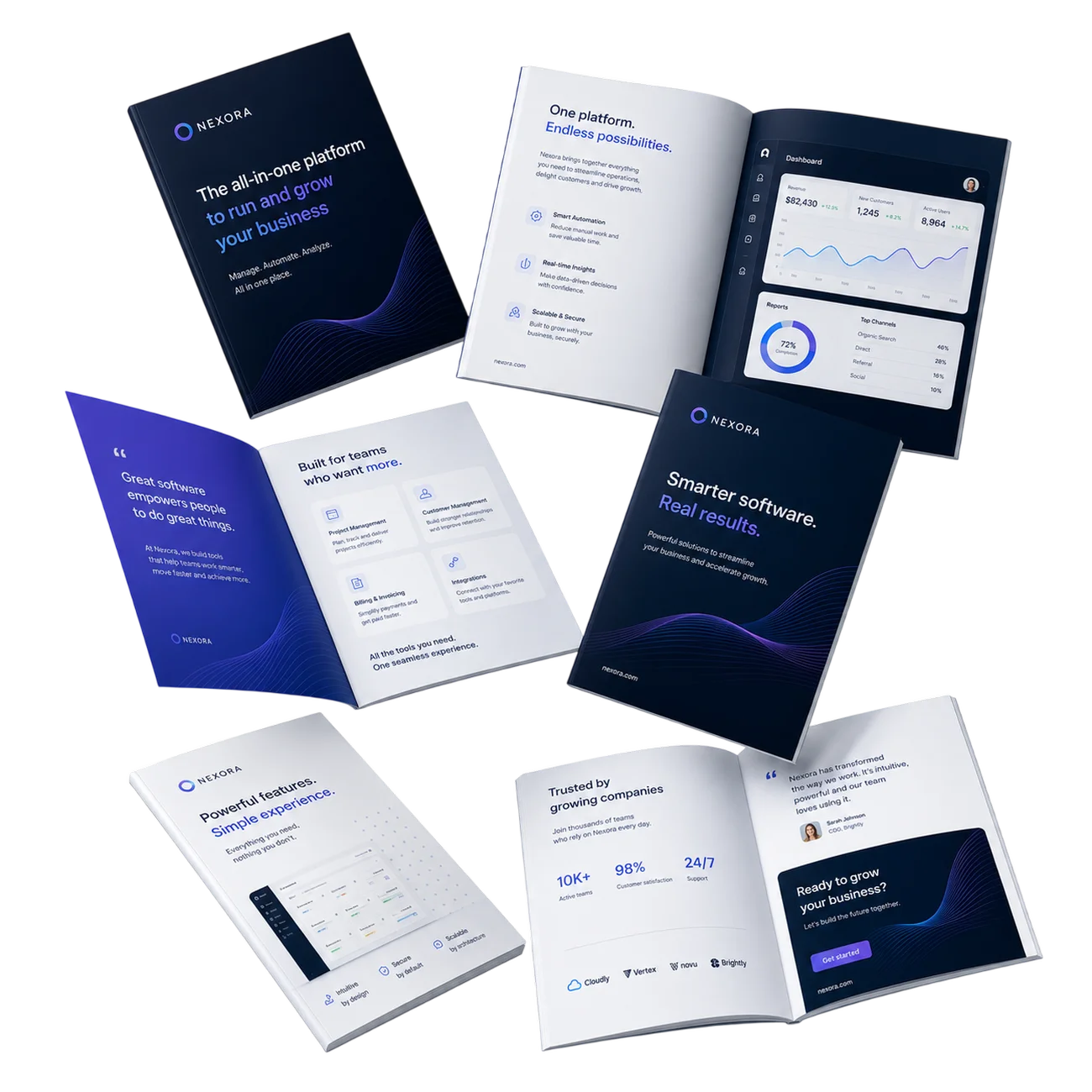
For a SaaS solution, the brochure has to accomplish something more difficult: making something intangible visible and comprehensible. The interface, the workflow, time savings, and regulatory compliance—all of these are elements that do not exist in physical form, yet they must still convince a purchasing committee made up of people with very different backgrounds.
A brochure poorly calibrated for this context doesn't convince anyone. It passes through the hands of decision-makers without anchoring an argument, without responding to technical or financial objections, and carries no weight in the final decision.
Tailor content to each SaaS contact
A one-size-fits-all brochure that tries to appeal to everyone ends up appealing to no one. Best practice in B2B SaaS is to provide multiple versions, or at the very least, a structure that clearly addresses the different types of decision-makers, each with their own approval criteria.
- 🔒Data security: hosting, certifications, RGPD compliance, ISO 27001
- 🔌Available integrations: APIs, connectors, compatibility with existing stack
- 🏗️Technical architecture: SaaS cloud, on-premises, hybrid
- 📈Scalability: how the product scales up
- 🛠️Support and SLA: guaranteed uptime, response time, escalation procedures
- 💶Clear pricing model: monthly/annual subscription, per user, per volume
- 📊Measurable ROI: cost reduction, productivity gains, payback period
- 📋Contractual commitments: duration, termination conditions, penalties
- 🔄Total cost of ownership: onboarding, training, maintenance, updates
- ⚡Key functionalities and concrete use cases in your sector
- 🖥️Interface previews: screenshots, demo, simplified user path
- ⏱️Time to learn: learning curve, onboarding
- ✅Customer references in its sector with concrete results
- 🎯Clear positioning: what it's for, who it's for, why you rather than someone else
- 🏢Years in business of the company: seniority, size, recognized customer references
- 🚀Product vision: roadmap, planned development, solution sustainability
- 🤝Long-term partnership and support arrangements

Recommended structure for a SaaS brochure
The logic is reversed compared to classic B2B: problem first, product second. Select a block for details.
The problem
Start with the pain point, not the product
Starting with the prospect's pain point anchors relevance from the very first seconds. Nobody reads a brochure to discover a solution they're not yet looking for.
- Use concrete figures: "Your teams spend X hours a week on...".
- Use the vocabulary of the target industry, not the publisher's internal terminology
- Position the problem before any product or team presentation
Key value
The value proposition in a nutshell
No product jargon. Wording that the prospect can repeat to his manager without having memorized it. Concrete, quantified if possible.
- Format: «[Product] enables [target] to [measurable benefit] without [main constraint]».»
- Quantified if possible: «-30% processing time» is better than «efficiency gain».»
- Test: if a salesperson can't rephrase it in 10 seconds, it's too complex.
Features
Key features
3 to 5 features at most, presented in terms of customer benefits, not as a technical list. The prospect wants to know what they get out of it, not what the product does.
- «Automatic report generation» rather than «advanced reporting module»
- Associate each feature with the decision-maker profile that benefits most from it
- Illustrate using actual screenshots, never generic mockups
Social proof
Social proof
Customer logos, usage figures, short, sourced verbatim. In B2B SaaS, seeing recognized names removes the main obstacle: the perceived risk of an intangible purchase.
- Logos of well-known brands in the target industry: a logo is worth more than a long testimonial
- Actual usage figures: number of active users, volume processed, length of contracts
- Short, attributed verbatim quotes: name, title, company—never an anonymous quote
Trust signals
Technical reinsurance elements
Security, certifications, hosting. Not a full paragraph—just the key points that the CIO and CFO look for at a glance.
- Certification logos (ISO 27001, HDS, SOC 2) more effective than a descriptive paragraph
- A word about hosting: data localization, redundancy, guaranteed uptime
- The complete technical details are included in a separate technical data sheet, not in the brochure.
Call to action
The call to action
In SaaS, offer a demo rather than a simple «contact». It's less engaging for the prospect, and more qualifying for the sales team.
- "Request a demo" reduces friction vs. «Contact us» or "Request a quote".
- QR code on the print version: direct link to schedule an appointment (Calendly, HubSpot Meetings)
- Repeat the call to action on the cover AND on the last page—reading isn't a linear process


Generic brochure vs. SaaS sector brochure
In B2B SaaS, segmentation pays off, especially in long sales cycles where the brochure is viewed multiple times by multiple people.
A single document for all targets and sectors
Partial reading, poor memorization, low commercial commitment
Tailored to decision-maker profiles: CIO, CFO, business unit manager
Each reader finds his or her own arguments, better internal circulation
One version per industry: banking, insurance, HR, logistics…
Industry-specific references and use cases, enhanced credibility
Tailored to a specific prospect or target account
Maximum commitment, reserved for strategic accounts with high stakes
Case Study: The UBI Solutions Sales Brochure
UBI Solutions commissioned us to design its sales brochure. Their business is in B2B IoT—not SaaS—but it faces the same challenge of selling to multiple decision-makers.

UBI Solutions sells a B2B IoT solution with a sales cycle involving multiple decision-makers: CIOs, CFOs, and business unit managers. The challenge was to create a document that could circulate independently among these stakeholders without losing clarity for any of them.
Structure inspired by the logic described above: problem before product, social proof and real screenshots of the interface, concise technical reassurance, and a repeated call to action on the cover and the last page.
A single brochure, ready to be distributed via email or in print, that meets the criteria of the three decision-maker profiles without requiring a prior oral presentation.
Is your brochure adapted for SaaS B2B?
Six questions about your current media. Less than a minute.
Sales brochure - SaaS B2B
Do you have a B2B SaaS brochure project?
Custom-designed solutions: structure, content, and design tailored to long B2B sales cycles involving multiple decision-makers. Get a quote within 24 hours.
See the brochure page